How to Tell Real Leather from Synthetic
The word leather appears on a great many labels, and it does not mean one thing. It can describe the top surface of a hide, a layer split from the middle of it, scraps glued back together, or a synthetic sheet that imitates the look. Knowing which you are looking at tells you how the shoe will crease, breathe, age and wear.
This article covers the grades of leather in order of quality, the labels that mislead, and a set of checks you can carry out in a shop with nothing more than your eyes and hands. It also explains why two parts of the same shoe are often made from very different materials.
What the word leather covers
In broad terms, leather is animal skin that has been tanned to make it stable and resistant to rot. Tanning is what turns a perishable hide into a durable material, and it is the reason leather holds its shape, repels a degree of water and develops a patina with use.
Real leather sits somewhere on a scale of quality. At the top is the full thickness of the hide with its natural surface intact. In the middle are layers split off below the surface, with an artificial finish applied to replace the grain that was removed. At the bottom is leather that has been shredded and rebonded with a binder, which behaves more like a composite board than like hide.
The grades, in order
Full grain is the outer surface of the hide, with the grain intact and the natural markings left visible. It is the strongest part of the leather, because the fibres are densest there, and it breathes best. It creases finely and ages into a patina.
Top grain usually refers to the outer surface after light sanding to remove blemishes, before a finish is applied. Some grain remains, but the natural surface is partly erased.
Corrected grain has had the surface sanded heavily and an embossed or sprayed finish applied to give it an even look. It is forgiving of scars and insect marks, but the finish can crack where the shoe flexes, and the leather beneath it is thinner in character.
Split leather is a layer taken from below the surface, which has no natural grain of its own. It is usually given an artificial grain finish. It is weaker and less breathable than top grain, and cheap furniture and shoes use a great deal of it.
Bonded leather, also sold as reconstituted or composite leather, is made from leather fibres and dust bound together with a polymer and pressed into a sheet. The leather content can be low. It peels and flakes as it ages, because the sheet has no fibre structure to hold together.
Synthetic materials such as polyurethane, PVC and microfibre imitate leather without containing animal skin. They are uniform, water-resistant to a degree, and cheap, but they do not breathe well and they do not mould to the foot the way hide does.
Checks you can make in a shop
These tests are quick and none of them damages the shoe.
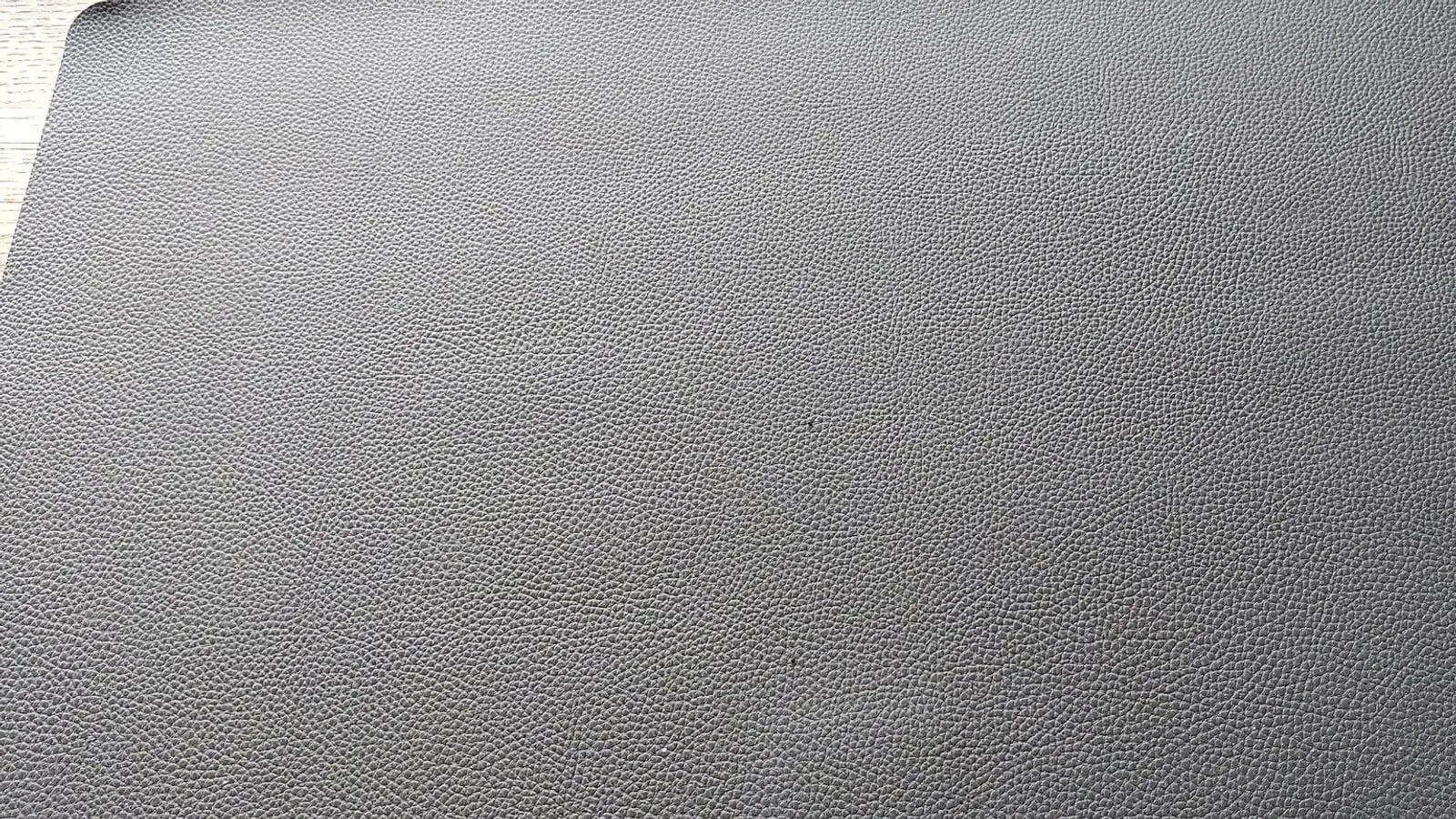
- Look at the grain. Real grain varies across the surface: pores change size and distribution, and no two areas match exactly. An identical pattern repeating in a regular grid is almost certainly printed or embossed.
- Look at the cut edge. On a real leather edge you can usually see a fibrous, slightly matted cross-section. A synthetic edge is smooth and uniform, and a bonded edge can look like compressed dust.
- Press the surface. Push a thumb into the leather and watch it. Good leather wrinkles in fine, radiating lines and springs back. Synthetic material wrinkles in broad, rounded folds or not at all.
- Flex it. Bend the upper sharply where the toe creases. Leather creases finely; coated materials form a shallow fold and can lift at the finish.
- Smell it. Leather has an earthy, animal scent. Synthetic material smells of plastic or glue. This is easier to judge on the inside of the shoe, away from polishes.
- Test with a drop of water. On unfinished or lightly finished leather, a drop darkens the surface and sits before being absorbed. On most treated leathers and on synthetic sheets, it beads and rolls off. Do not do this on suede or nubuck, and avoid the risk on a shoe you have not yet bought.
Grain and the repeat test
The single most reliable check is repetition. Natural grain is irregular. If you find the same pattern of pores, the same small scar or the same crease pattern appearing at regular intervals across the shoe, you are looking at a printed or embossed surface, whether the base is real leather or synthetic.
Check two areas that are far apart, such as the toe and the side of the heel. Genuine hide looks different in each. An embossed or printed sheet repeats.
Where the leather sits in the shoe
Quality is not uniform across a pair. Hides are large, and makers use the strongest, most even areas for the parts that will be seen and stressed, and the looser or marked areas for the rest.
The parts that matter most are the vamp, the front of the upper over the toes, and the quarter, the side panels. These receive the most flexing and are the most visible. Makers often use better leather there and something thinner or split for internal parts and linings. That is normal and not dishonest, but it means a shoe can be described as leather while only part of it is.
Look also at the lining. A leather lining is more comfortable and lasts better than a synthetic one, and it is a sign of a maker willing to spend where it is not seen.
What labels do and do not guarantee
Labelling rules differ between countries, and terms such as genuine leather, real leather and full grain are not always legally defined in the same way. In practice, the phrase genuine leather is used loosely and often appears on split or corrected grain. It tells you the material contains hide, not that it is high quality.
Rather than relying on a word, rely on the checks above, on the price, and on the reputation of the maker. A shoe with a genuine leather upper will still fail if the leather is thin, poorly finished or wrongly lasted.
What it means for the life of the shoe
Leather moulds to the foot, breathes, and can be conditioned and repaired. Synthetic uppers do not mould, hold moisture against the skin, and cannot be fed or polished in the same way, though they are easier to wipe clean. Bonded and heavily coated materials fail first at the crease, where the coating cracks and lifts.
If you want a shoe to soften, stretch slightly where it presses and last for several seasons, grain leather with a leather lining is worth looking for. If you want a light, cheap, easily cleaned shoe for occasional use, a synthetic may serve perfectly well, provided you buy it at the fit you want on day one, because it will not adapt to you later.