Resoling and Shoe Repair: What Is Worth Fixing
A shoe that has worn through at the sole is not necessarily finished. Depending on how it was built, it may be resoled, patched or relined, and the decision of whether to repair comes down to three things: whether the construction allows it, whether the upper is still sound, and whether the cost makes sense against replacing the pair.
This article explains what a cobbler can realistically do, how stitched and cemented shoes differ when a sole needs replacing, the arithmetic of repair, and how to describe a fault clearly enough that the person doing the work understands what you want.
What a cobbler can do
The trade covers more than resoling, and some of these repairs are quick and inexpensive.
- Resoling. Replacing the outsole, either with a like-for-like sole or a thinner one that suits the shoe’s construction.
- Adding a protective plate. A thin rubber or plastic layer on the forepart or the heel, fitted before wear reaches the sole, that takes the abrasion instead.
- Replacing heels. Usually straightforward, because heels are made to be replaced and are fastened with screws, nails or glue.
- Replacing or patching the heel lining. Common, and effective, when the lining rubs through.
- Restitching. Re-sewing a seam that has opened, if the surrounding material is strong enough to hold a new stitch.
- Stretching. A modest widening or easing at a specific point, using a proper stretcher.
- Filling and colouring. Blending scuffs and restoring colour on leather, which improves appearance rather than structure.
Resoling a stitched shoe
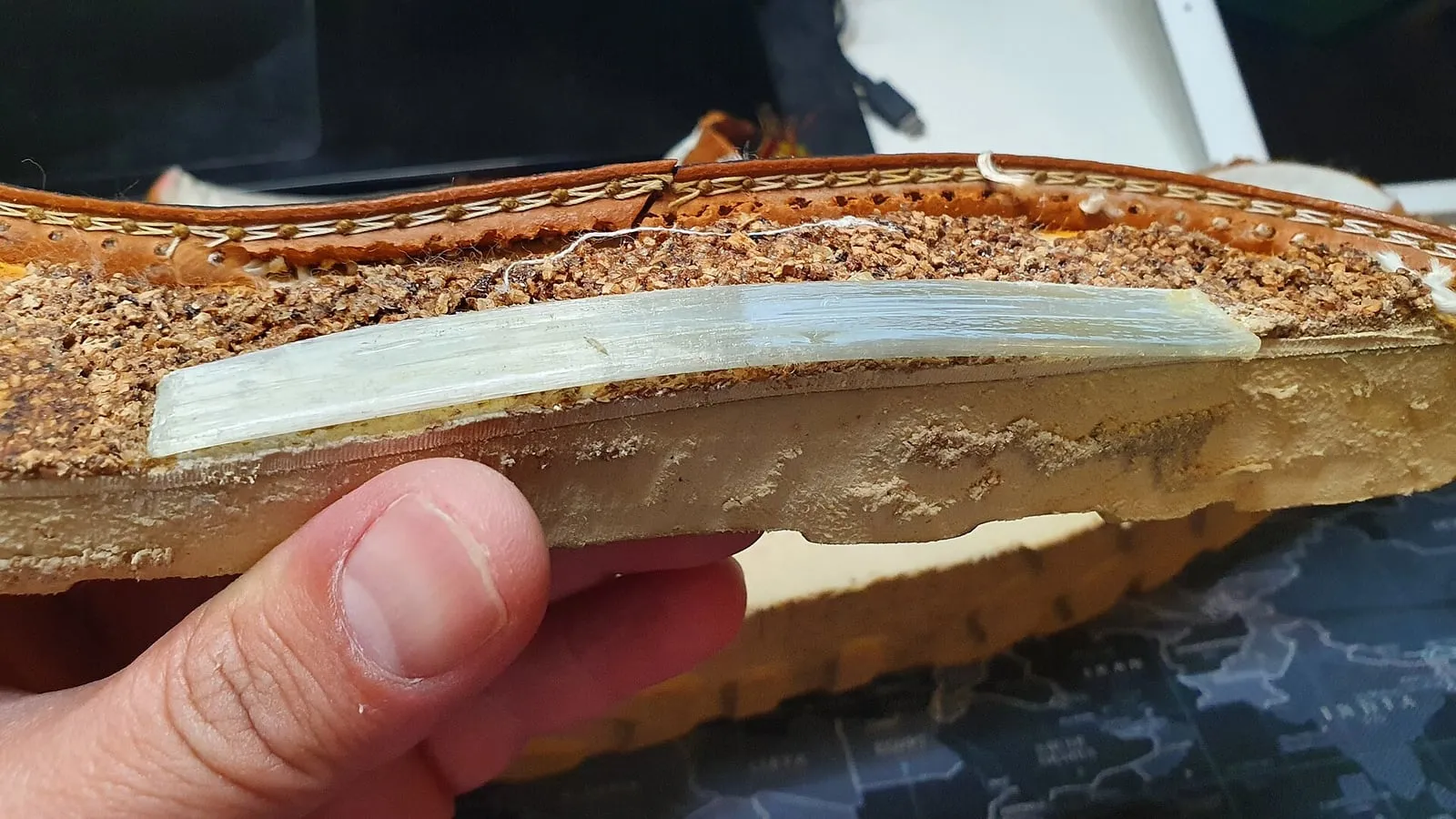
Stitched shoes are built for repair. On a goodyear-welted shoe the cobbler unpicks the stitching that holds the sole to the welt, removes the sole, and attaches a new one, often replacing the cork filler that sits under the foot. The upper, the insole and the welt are untouched, so the shoe keeps its shape. This can be done several times over the life of the shoe, and when the welt itself eventually wears, that too can be replaced.
Blake-stitched shoes are resoled by stitching through the insole from the inside. It is quicker and less expensive, but each resole perforates the insole a little more, so the number of times it can be done is limited. A Blake-Rapid shoe, with its extra under-arch stitch, is more robust in this respect.
For both, the value of resoling depends on the upper and insole being sound. A resoled shoe with a cracked upper is still a cracked shoe.
Resoling a cemented shoe
Cemented shoes have their soles glued on. A cobbler can remove the old sole by heating the bond and pulling it away, then glue a new sole in place, but the operation is less clean. The layer that carried the original bond is disturbed, and the new bond is generally weaker than the first. Shoe goo, heat and force can also distort the shape of a light shoe.
Resoling a cemented shoe is possible and sometimes worth doing, particularly on a light dress shoe or a trainer where the upper is still good. But it is usually a once-only repair, and on a moulded trainer where the sole is fused to the upper, it may not be possible at all.
Heels, taps and linings
These smaller repairs are worth doing early, because they protect the parts that are expensive to replace.
A worn heel is the most common repair, and it is best done before the wear reaches the heel seat, the structural layer beneath. Once the seat is damaged, the repair is larger and the shoe may sit crooked.
A protective tap on the toe of a sole or the back edge of a heel takes the abrasion that would otherwise cut into the sole. This is a genuinely good use of a repair budget, because it costs little now and postpones a resole.
A heel lining that has rubbed through will begin to scrape the skin. Replacing the panel or inserting a patch is a small job that rescues an otherwise sound shoe. Catching it before the stiff counter behind the lining is exposed is what keeps the repair small.
The arithmetic of repair
Repair makes sense when the cost is a fraction of replacement and the result will last a good while. A resole that costs a modest share of the price of a new pair, on a shoe whose upper has years left, is good value. The same resole on a shoe whose upper is thin and cracking is money spent on a shoe that is about to fail elsewhere.
It also helps to ask what you would replace the pair with. If the shoe is a shape that suits your foot and a model that is no longer made, repair has extra value, because replacing it may not be possible at all. If it was a cheap shoe that never fitted well, the honest answer is often to replace rather than repair.
Time matters too. A good repair may take days or a week, during which you need another pair. That is not a reason to avoid repair, but it is worth planning for.
Finding someone competent, and describing the fault
Look for a repairer who talks about construction rather than only about price, who can tell you whether a shoe is stitched or cemented, and who will say when a repair is not worth doing. A shop that repairs its own work and explains what it found is more likely to do a careful job.
Describe the fault precisely, and bring the shoes rather than a photograph.
- Say where it hurts or fails: the inner heel, the outer ball, the top of the toes, the seam behind the laces.
- Say what the shoes are used for: daily walking on pavement, occasional formal wear, wet weather.
- Say what you want: a durable sole for walking, a thin sole to keep the shoe’s shape, a lining patch, a small stretch.
- Ask what the repairer would do and what it will not fix.
When repair is not worth it
Repair will not rescue a collapsed midsole on a moulded trainer, a cracked or torn upper where it flexes, a shoe whose shape has gone from repeated soaking, or a cemented sole that is already coming away after a previous resole. In those cases, the money is better kept for a replacement.
The wider point is that repair rewards shoes built to be repaired. If you want to own a pair for a decade and resole it as needed, the decision is made at the point of purchase, not at the point of failure.